
Blog & Insights

Expert perspectives on web development, mobile apps, SaaS, and business technology from the Wealth Profusion team

How to Validate Your SaaS Idea Before Writing a Single Line of Code

How to Validate Your SaaS Idea Before Writing a Single Line of Code

Building the wrong product is the most expensive mistake in software. Before you invest in development, here is a structured framework for validating that real people will actually pay for your SaaS idea.

The SaaS graveyard is full of beautifully built products that nobody wanted. Founders who spent six months and $50,000 building a platform only to discover there was no market. The single most important thing you can do before investing in development is validate that your idea solves a real problem people will pay to have solved.

Step 1: Define the Problem, Not the Solution

Most founders fall in love with their solution before they properly understand the problem. Start by writing a one-sentence problem statement: "X type of person struggles to do Y because of Z." Validate that statement before anything else. Talk to 10 people who fit your target customer description and ask them about the problem — do not mention your solution yet.

Step 2: Build a Landing Page First

Before writing any code, build a simple landing page that describes your SaaS as if it already exists. Include a clear value proposition, a feature list, and a "Get Early Access" or "Join Waitlist" CTA. Drive traffic to it with Google Ads or LinkedIn. If you cannot get 100 people to give you their email address with $500 in ad spend, that is important signal.

Step 3: Define Your MVP Ruthlessly

An MVP is not a smaller version of your full product — it is the minimum set of features required to deliver the core value to your first customers. Strip everything out. What is the single workflow your first user needs to complete? Build only that. You can add everything else in the next sprint.
Log in to rate this article

Native vs Cross-Platform: Which Mobile App Approach Is Right for Your Business?

Native vs Cross-Platform: Which Mobile App Approach Is Right for Your Business?

Choosing between native iOS/Android development and cross-platform frameworks like React Native or Flutter is one of the most important decisions in any mobile project. Here is how to think through it.

The question comes up in nearly every mobile project discovery call: should we build native apps for iOS and Android separately, or use a cross-platform framework to share a single codebase across both platforms?

There is no single right answer — but there is a right answer for your specific situation. Here is how we think through it.

The Case for Native Development

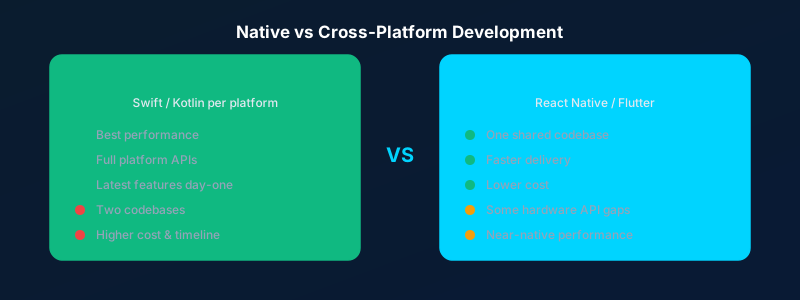
Native apps — Swift/SwiftUI for iOS and Kotlin/Jetpack Compose for Android — give you the best performance, the smoothest animations, and full access to every platform-specific feature. If your app relies heavily on device hardware (camera, ARKit, health sensors, NFC), or if you need cutting-edge platform features the day Apple or Google releases them, native is the right choice.

The Case for Cross-Platform

React Native and Flutter allow you to share 80-90% of your codebase across iOS and Android. For most business applications — tools, dashboards, marketplaces, booking apps — this is entirely sufficient. You reach both platforms faster, at lower cost, with a single development team. Performance has improved dramatically in recent years and is indistinguishable from native for most use cases.

Our Recommendation Framework

Choose native when: your app is deeply hardware-dependent, you need maximum performance, or you are building a consumer product where UI polish is a primary differentiator. Choose cross-platform when: you need to ship fast, you have budget constraints, or your app is primarily business logic and data display rather than hardware interaction.

Log in to rate this article

Why Your Business Website Is Losing You Customers (And How to Fix It)

Why Your Business Website Is Losing You Customers (And How to Fix It)

Most business websites fail at the one job they were built to do — convert visitors into customers. Slow load times, unclear messaging, and broken mobile experiences are quietly costing you revenue every single day.

Your website is your most important salesperson — it works 24 hours a day, seven days a week, and never calls in sick. Yet most business websites are quietly failing. Visitors land, look around for a few seconds, and leave. No inquiry. No sale. Just a bounce.

The good news? Most of these problems are fixable. Here are the four most common reasons your website is losing you customers.

1. It Takes More Than 3 Seconds to Load

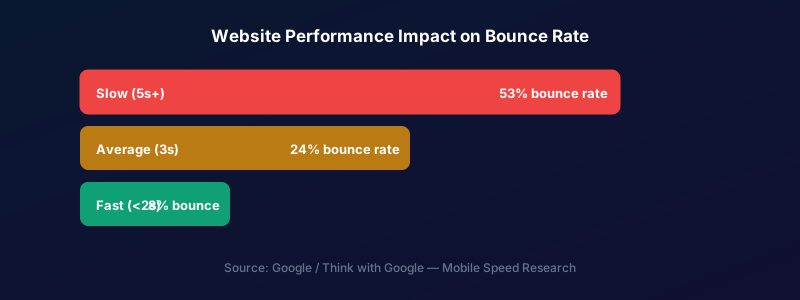
According to Google, 53% of mobile users abandon a site that takes longer than three seconds to load. If your page speed score is below 70, you are losing more than half your mobile visitors before they even see your content. Image compression, caching, and minified CSS/JS alone can cut load times in half.

2. Your Value Proposition Is Buried

A visitor should understand exactly what you do and who you do it for within the first five seconds of landing on your homepage. If your hero section opens with "Welcome to our website" or a vague tagline, you have already lost them. Lead with your clearest, most specific value statement.

3. It Is Not Built for Mobile

Over 60% of global web traffic comes from mobile devices. A responsive layout is not optional — it is the baseline. But true mobile optimization goes beyond making things fit on a smaller screen. Touch targets, font sizes, and form inputs all need to be specifically designed for thumbs, not cursors.

4. There Is No Clear Next Step

Every page on your website should have one clear call to action. Not three. Not a footer menu and a contact form and a chat widget competing for attention. One primary action you want the visitor to take. Make it visible, make it compelling, and make it easy.

Log in to rate this article
Back
1 2 3 4
Next

Showing posts 16–18 of 18